
The contact-centre planning guide
How to choose a call centre phone system
A call centre phone system needs to fit how your agents work and how callers expect to be helped. Start with your busiest customer journeys, then assess the voice service, routing and CRM connections in a realistic demonstration. For a contact centre using several channels, this guide focuses on the telephone service and its agreed integrations.
Describe the operation before comparing features
Write down whether the team handles inbound service, outbound sales, appointment reminders or a mixture of work. Identify opening hours, languages, locations and the systems agents already use. Explain what a good call outcome looks like, whether that is a resolved question, a booked appointment or an accurately recorded follow-up.
Use a small set of representative scenarios for every supplier demonstration. For example, follow an existing customer through identification, a transfer to another team and a promised callback. Seeing the same journey in each system makes differences easier to assess than comparing unrelated demonstrations.
Understand the busiest hour
Measure when calls arrive, how long conversations last and how much work agents complete afterwards. Separate ordinary demand from campaign spikes. Record the number of people available to answer at those times, including the effect of breaks, training and shift changes.
Ask how call capacity, queue limits and any dialler are sized together. Do not assume the number of agent licences is also the number of calls the voice connection can support. Have the supplier explain what callers and agents experience when capacity is reached, and how additional capacity would be arranged.
Design routing that a caller can understand
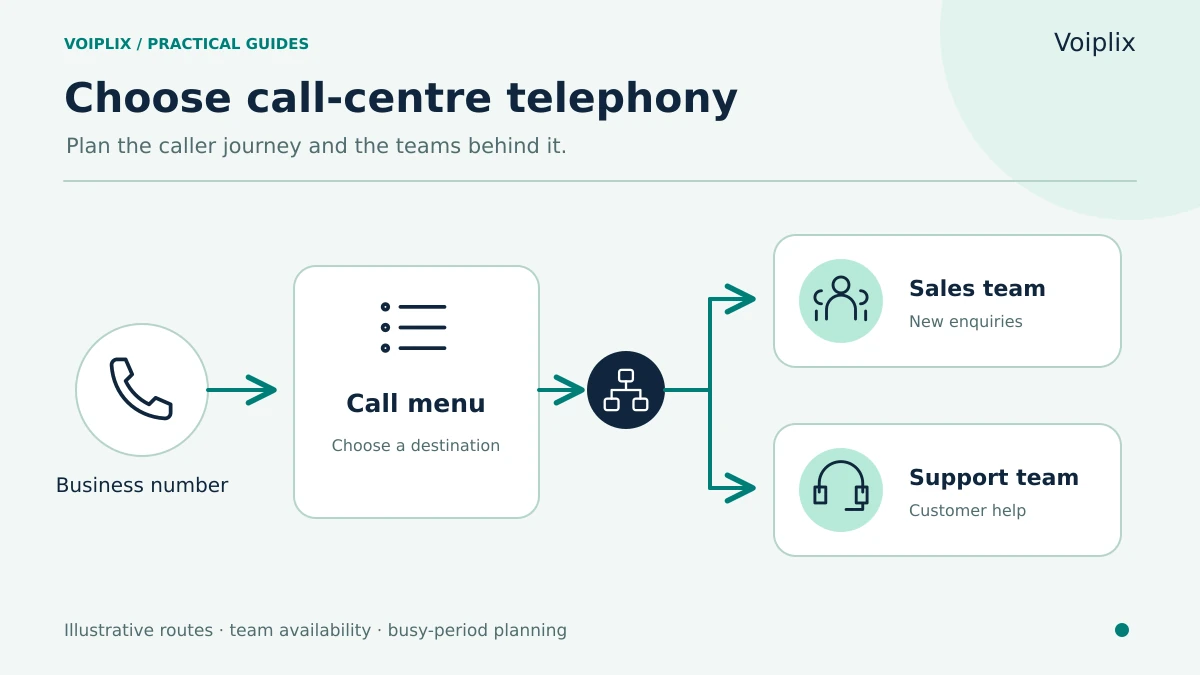
Start with a short route to a useful person. Keep menu choices distinct, provide a sensible response when nobody answers and decide what should happen outside business hours. Test the wording aloud. A menu that makes sense on a planning document can still sound confusing to someone calling for the first time.
Discuss queue announcements, overflow destinations and callback handling as parts of one customer journey. Define who can change them and how changes will be checked. Make sure a public holiday or a temporary staffing problem can be handled without an improvised change to the entire phone system.
Make the agent workflow part of the trial
Ask agents to try answering, holding, transferring and ending calls using their normal headset and workstation. Check whether the right customer record appears and how notes are saved. Include an unknown caller, a shared business telephone number and a customer with more than one record.
Give supervisors a separate set of tasks. Can they identify a struggling queue, find the owner of a follow-up and make an approved routing change? Evaluate the amount of training and administration required. A feature is only valuable if the people responsible can use it confidently during a busy shift.
Choose reporting that leads to decisions
Decide which questions the reports need to answer before choosing a dashboard. You may need to understand unanswered demand, repeat contacts, queue performance or completed follow-ups. Ask for precise definitions of each measure so managers do not compare numbers that describe different events.
Review how transferred calls, abandoned calls and agent after-call work are represented. Confirm whether you can export the records you need and who can access them. Where recording is proposed, agree the purpose, access and retention with the people responsible for privacy and policy before enabling it.
Agree support, costs and acceptance in writing
Separate agent licences, telephony usage, numbers, integrations, onboarding and optional services in the quotation. Ask about contract terms, minimum commitments and the cost of seasonal changes. Model a normal month and a busy month using your own calling pattern.
Before launch, agree which faults count as urgent, how incidents are reported and how your team can reach support if the phone service itself is affected. Run an acceptance session with agents, supervisors and the project owner. Record any remaining issues and their owners instead of treating the first connected call as the end of the project.
Your questions, answered
A few common questions.
Practical answers before you take the next step.
Should we choose the phone system or the CRM first?
Start with the customer journey and decide which system owns customer records, call activity and follow-up tasks. Then assess the connection between them. Buying each system in isolation can leave agents repeating the same work.
What should be included in a call-centre trial?
Include realistic inbound and outbound calls, transfers, missed calls, queue overflow and after-call tasks. Involve agents as well as managers, and use your normal devices and network arrangements.
Which performance measures matter most?
Choose measures connected to your operation's goals. Answered demand, waiting time, repeat contact and completed follow-ups may be useful, but agree definitions and review the customer experience alongside the numbers.
Explore the next step
Keep the useful connections going.
Start with a conversation
Turn the reading into a useful next step.
Tell us about your offices, agents, traffic and existing systems. We’ll help scope the calling service, devices and integrations around your business.